Table of Content
It's an extremely well-rounded system that just about aced my tests, and it's the only router aside from the Nest Wifi that I've ever awarded Editors' Choice. Nest Wifi is the better overall value between the two, and easily strong enough for most homes, but if you're itching for an upgrade (or if Wi-Fi 6 is a must at this point), then the ZenWiFi AX belongs right at the top of your list. And then there are the systems to the left of Nest Wifi in that chart. Each of them supports Wi-Fi 6, which explains the higher top transfer speeds.
Welcome to the totally new Google Home app, now available in Public Preview. If you’re looking for a router or mesh system that’s going to deliver the highest possible throughput possible, the Nest Wifi ain’t it. The name of Google’s game is simplicity and signal strength via mesh techniques, not raw numbers. Again, if this is your aim, go for a more specialized, old-school router.
Eero 6 Plus
Of course, if you already have your quota of smart speakers and own a solid mesh system such as Google Wifi, making the jump to the Google Nest Wifi makes little sense. If you don’t however, we strongly recommend investing in the Nest Wifi. Mesh routers often have fewer ports than single-point routers, too. Some lack USB jacks, and others limit you to only one or two spare Ethernet ports for wired connections to media streamers, smart home bridges and other common peripherals. Some mesh routers feature no additional ports whatsoever on the satellite extenders.
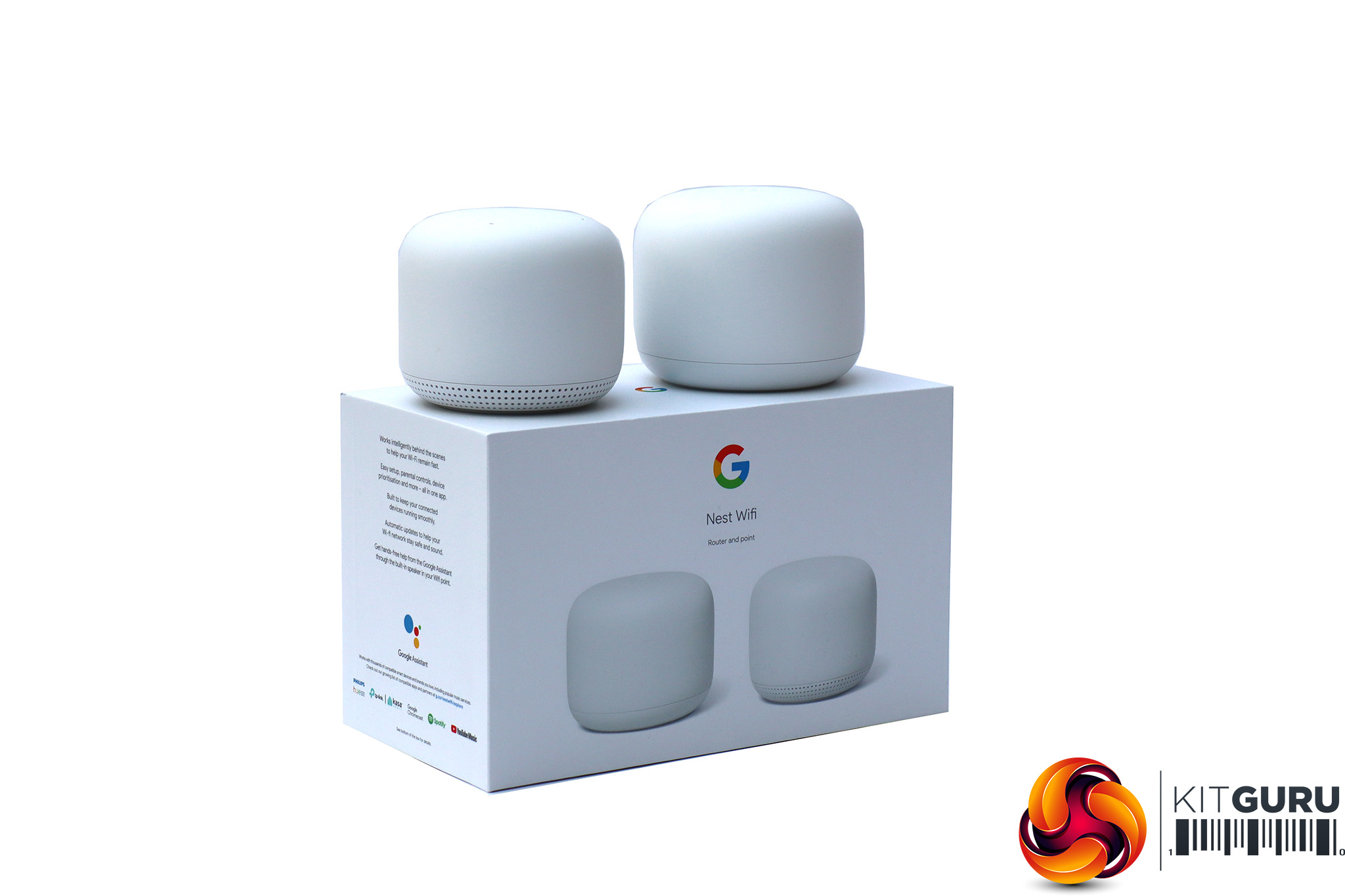
Depending on the layout of your home, you can put the Wifi points one or two rooms away from one another to maximize the Wi-Fi coverage. The Google Wifi app can help determine the best location by measuring the connection between units. Physically, one of the key differences between the base router and the access point is the speaker grille on the bottom of the access points. These WiFi satellites cleverly double as Google smart speakers, like a Google Home Mini, and can play music, answer questions and control other smart devices in your home.
A great three-piece setup for large homes
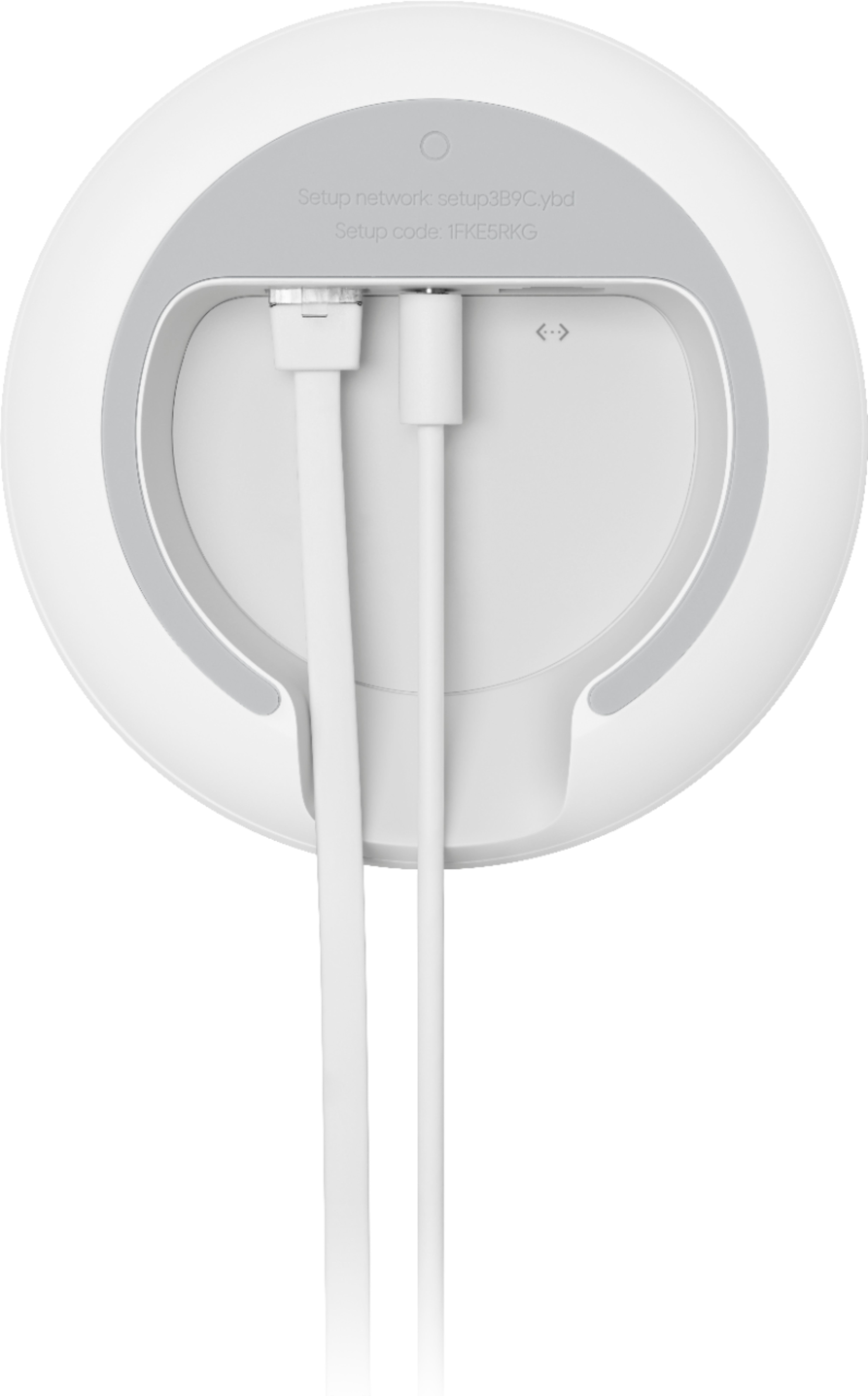
The router lacks a USB connector or a power switch, while the extensions do without any wired connection, so they can't be used as cabled access points the way Netgear Orbi hardware can. Composed of devices that look like big plastic marshmallows, the Nest WiFi mesh devices are small and easy to hide. In addition to stashing them on a shelf, they fit on a windowsill or on a coffee table. By contrast, the Point extensions are a little smaller with a 4.0-inch diameter and 3.4-inch height. Both have shotgun-cooling holes at their bases and are tiny compared to comparable Netgear Orbi devices, which are larger and measure nearly 10 inches tall.
Once you have this Google Wi-Fi router connected, you will know the status of the router by the indicator LED light. You are free to purchase more mesh points if you would like to vastly expand your coverage to ensure that not a single spot in your smart home network lacks a signal. But first, before getting this unit, you might want to see our comparison of the Google Nest vs Orbi. You may also be interested in the Turris Omnia 2GB review, which has powerful Qualcomm SoC inside and automatic updates. A single mesh router gives you 2,200 square feet making it a shoo-in with our choices for the best Wifi router for long range.
Agree to Continue: Google Nest Wifi
It’s even more popular than Eero, which first popularized the idea of a mesh router for better Wi-Fi coverage in a home. 3 Many Google devices will be automatically updated to support Matter. A traditional router the Nest Wifi is not, so you literally are not able to dig into its inner workings like you can older routers. If you need access to functions like port forwarding or some such, you better go for a more traditional model from the likes of Linksys or Netgear.
Once set up, the Google Wifi will stay connected to Google at all times and will log into your Google account each time you want to manage it. Together, these should give you far more options for which devices you can string together and give you more control of your burgeoning smart home. We do see marginally faster download speeds in MB/s on the 2.4GHz band from the Orbi over the Google Wifi.
There is also a three-piece set for $349 that covers 5,400 square feet, and you can buy additional points for $149 each. If you live in a smaller house or an apartment, you can buy just the router for $169. To compare, the $299.99 two-piece TP-Link Deco M9 Plus system can cover homes of up to 4,500 feet. That all adds up to the mesh router I would tell most people to consider first if they were thinking about buying one right now. But those who aren't committed to Google at this point would be wise to shop around, because better mesh values with comparable coverage are already available today. With a single mesh wifi point, you can extend your coverage up to 2,200 square feet.
It's not as integrated with Google's own services as we'd like, and the Google Home has some room to improve in terms of audio quality, but it's come a long way since launch. The node has an illuminated central strip, which lets you know if the device is connected. Fortunately, you can control its lighting level through the app, which is certainly thoughtful for those looking for complete darkness. As you can see, the wireless mesh connection system provided by Google WiFi is very interesting, but let's explain the strengths of this device compared to other alternatives on the market. The system itself will detect which node you should connect to, in order to have a better browsing speed and which is the most suitable band.
You can get similar coverage from rivaling systems with fewer units, sure, but the flexibility you get from having more units – just in terms of minimizing dead spots – is massive. Setup is also completely smooth, just like the Google Wifi’s hardware design – using a free iOS or Android app to facilitate the whole process. We’re not going to dig into the nitty gritty of the process, but the Google Wifi App will allow you to configure your network by first scanning the QR codes on the Wi-Fi point connected to your modem or gateway. Google not only has an edge in pricing on its hands, but it also has the sleekest designed Wi-Fi units and possibly the easiest setup of any offering.
And, that’s considering the two extra devices required to finish the process. For a reasonably affordable price point, there are more units on offer than most of Google’s rivals, as well as the best setup and management app so far. In essence, Google Wifi has set the standard of what a mesh Wi-Fi router should be, even if Samsung Connect Home or Netgear Orbi have been around longer. That’s because the Google mesh router combines a stripped-down design, straightforward installation, and full feature set with a very reasonable price tag. It also blends in well wherever you install it, and provides a robust, continuous connection no matter where you are in your area of coverage. Like most recent mesh-router systems, Google Wifi supports WPA2 wireless encryption.
First, you will have to download the Google Home application and register with your Google account. If you have never used the application, you will have to create a “Home” for your devices. The first Google WiFi node must be connected directly to your modem via network cable. However, if your house is wired and you have a switch, you can also place it at any other point in your home connected via network cable.

If $400 is a bit too much for your budget, know that there's a smaller version of this system called the Asus ZenWiFi AX Mini. It isn't as high-powered and it isn't a tri-band system like its big brother, but it comes with three devices that all support Wi-Fi 6 for $250, which makes it interesting. There was also a new dual-band ZenWiFi system last year called the ZenWiFi XD6 -- it performed quite well in our tests, but it only costs slightly less than the XT8. Between the three of them, the XT8 is the one I'd be looking to buy first. All of that makes it a future-ready upgrade pick at a fair price.
Originally hailing from Troy, Ohio, Ry Crist is a text-based adventure connoisseur, a lover of terrible movies and an enthusiastic yet mediocre cook. A CNET editor since 2013, Ry's beats include smart home tech, lighting, appliances, and home networking. The Google Wifi Mesh Router kicks your wi-fi systems into overdrive by giving you more coverage so you can have an optimal experience anywhere around your home. You can enjoy streaming all your 4K videos, and use the Google Assistant embedded to help you do just about anything to manage your day and handle all internet needs. Each unit of the Google Wifi has a reset button on the side to bring it back to factory default settings.
The network ran without a problem, reliably distributing my internet connection and playing everything from the latest Kevin Gates track to the sonatas of Domenico Scarlatti to the latest BBC World News headlines. The incoming connection's 235Mbps bandwidth dropped to 187Mbps at the router and 178Mbps at the extension, a 25 % decline. I set the Nest two-pack up in my three-story, 3,500-square-foot home, an older building with thick walls and lots of nooks and crannies. With the router in the basement and the extension a floor above, the two-piece Nest set ran without a problem for more than a week of testing. Because the router lacked the built-in smart speaker, I set up a Nest Hub nearby to provide that same functionality in that room.


No comments:
Post a Comment